How British Graduates are Re-skilling for a Digital-First Economy
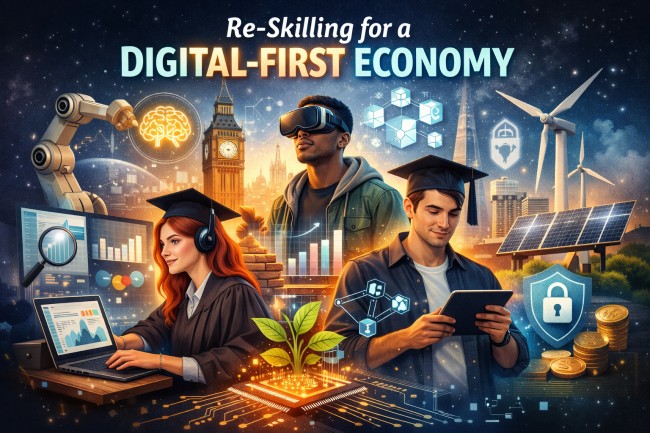
The British labor market is currently undergoing its most significant transformation since the Industrial Revolution. As we move deeper into 2026, the term “digital-first” is no longer just a corporate buzzword; it is the fundamental operating system of the UK economy. For recent graduates from London to Edinburgh, the degree certificate hanging on the wall is now seen as a starting point rather than a finish line. The rapid integration of automation, sophisticated data analytics, and decentralized finance has created a landscape where the ability to learn, unlearn, and relearn is the most valuable asset a professional can possess.
The Shift from Static Degrees to Dynamic Skills
For decades, the path to a successful career in Britain was linear: graduate from a reputable university, secure a graduate scheme position, and climb the ladder. Today, that ladder has been replaced by a complex web of interconnected digital skills. Employers are increasingly looking beyond traditional academic credentials, seeking candidates who demonstrate “digital fluency.”
This shift isn’t about everyone becoming a computer programmer. Instead, it’s about understanding how technology aughens specific roles. A marketing graduate now needs to understand algorithmic targeting; a history graduate entering the civil service needs to be comfortable with data visualization. The pressure to adapt is immense, leading many to seek help with assignments online as they juggle traditional postgraduate studies with the pursuit of industry-specific digital certifications.
The Rise of the “Polymath” Professional
In the current UK economy, specialization is being balanced with versatility. We are seeing the rise of the “T-shaped” professional—someone with deep expertise in one area but a broad ability to collaborate across digital disciplines.
For instance, consider the banking and investment sector. A traditional background in economic theory is still vital, but it must now be paired with an understanding of fintech ecosystems and blockchain applications. Students currently tackling complex modules in these fields often find that finance assignment help is a crucial resource for bridging the gap between historical financial models and the high-speed digital markets of 2026. This blending of skills ensures that graduates aren’t just tech-literate, but are capable of applying tech to solve high-level business problems.
Key Areas of Re-skilling for 2026
If you are a graduate looking to “future-proof” your career in the UK, several domains have emerged as non-negotiable:
- Data Literacy and Ethics: It is no longer enough to just collect data. Professionals must know how to interpret it and, more importantly, navigate the ethical implications of data usage under evolving UK regulations.
- AI Collaboration: Rather than fearing replacement by AI, British graduates are learning to “prompt” and manage AI tools to increase their creative and analytical output.
- Sustainability Tech: As the UK pushes toward Net Zero targets, “Green Digital” skills—using technology to monitor and reduce carbon footprints—are in high demand across every sector from construction to fashion.
- Cyber-Resilience: With the economy moving entirely online, understanding basic cybersecurity is now as fundamental as knowing how to use a word processor was twenty years ago.
The Role of Micro-Credentials and Continuous Learning
The traditional three-year degree is being supplemented by “micro-credentials.” These are short, focused bursts of learning that provide specific digital competencies. Many UK universities have started partnering with tech giants to offer these “stackable” credits.
However, the intensity of these courses can be overwhelming. The British academic standard remains rigorous, and the transition from theoretical study to practical digital application is steep. This is where the modern student’s toolkit has changed. Accessing expert guidance and structured support has become a standard part of the educational journey, ensuring that the quality of work remains high while the student focuses on acquiring new, practical skills.
Bridging the Gap: Academic Foundations and Market Reality
There is a growing realization that while technology changes, the need for critical thinking and structured analysis remains constant. The most successful graduates are those who can take a complex problem, break it down using traditional academic logic, and then solve it using modern digital tools.
In sectors like corporate finance or management accounting, the fundamentals haven’t changed, but the delivery has. Knowing how to balance a ledger is one thing; knowing how to automate that process while maintaining 100% accuracy in a cloud-based environment is another. This is why students often seek specialized assistance. Whether it is refining a dissertation or getting specific help with a technical report, the goal is the same: achieving excellence in an era where “good enough” is quickly bypassed by automation.
Overcoming the “Digital Divide” in the UK
It is important to acknowledge that re-skilling isn’t equally accessible to everyone. The UK government and various NGOs have launched initiatives to ensure that graduates from all backgrounds can access high-speed internet and the hardware necessary for digital mastery.
The “digital-first” economy should be an inclusive one. For many, this means utilizing online platforms to level the playing field. Online resources allow a student in a remote part of Wales to access the same high-level academic support and tutoring as someone living in the heart of London’s “Silicon Roundabout.”
Strategic Networking in a Virtual World
Re-skilling isn’t just about what you know; it’s about who you know in the digital space. The “Old Boys’ Network” is being replaced by LinkedIn groups, Discord servers, and professional Slack communities. British graduates are learning to build personal brands online, showcasing their portfolios through GitHub, Behance, or personal blogs.
This digital presence acts as a living CV. It shows potential employers that the candidate isn’t just claiming to be “digitally savvy” but is actively participating in the digital economy.
Conclusion
As we look toward the horizon, the pace of change shows no signs of slowing down. The graduates who will thrive are those who view their education as a lifelong project. The “Digital-First” economy rewards curiosity and adaptability.
By combining the prestigious traditions of British academia with a forward-thinking approach to technology, the current generation of UK graduates is well-positioned to lead on the global stage. They are proving that while the tools may change, the British spirit of innovation and rigorous inquiry remains as strong as ever.